Important Note: I am organizing this trip report into separate sections to both make it easier to read and to organize the geographical areas for your future trip planning.
- Part I comprises part of Wednesday and part of Saturday covering El Malpais National Monument. This breaks the timeline, but puts all of El Malpais in one section.
- This section, Part II covers the rest of Wednesday, Thursday, Friday, and Saturday morning in the Apache and Gila National Forests.
- Part III covers El Morro National Monument from Saturday evening through Sunday afternoon.
- Part IV is a photo gallery of the inscriptions of El Morro National Monument. I separated this out as they will be of only limited historical interest for most folks.
II. Apache and Gila National Forests
Wednesday, May 20th (continued)
Quemado Ranger District, Gila National Forest
Leaving El Malpais via highway 117, I took SR-36 to Quemado [kee-MOD-oh] where I stopped at the Apache NF District Ranger Station for advice. The nice lady there explained my options and gave me a report of good road conditions for Apache National Forest.
I took SR-32 south from Quemado, then turned east on SR-103 which changed from pavement to gravel just before Quemado Lake. The lake was extremely low as this area of the state has been exceptionally dry. There were still a number of folks fishing and campgrounds were nice enough. The one closest to the lake, Juniper, had lots of RVs all in one small area as it offers full hookups. There were several more campgrounds and there were very few people in those. The El Caso campground is farther from the lake and has several small units in a riparian area and there is no fee. However, I drove on as it was only 4pm and I wasn't ready to stop. Though I wish I'd taken a photo or two of this area.
Curiously, I saw two groups of very weathered backpackers walking in this area (more worn looking than your typical Rocky Mountain backpackers with which I'm more familiar). They were hiking along the road intent on going somewhere, but I couldn't figure out where as there didn't seem to be any specific attractions in the direction they were going. Later I realized I'd been driving back and forth along the continental divide. Looking at my maps I discovered the Continental Divide National Scenic Trail runs through the area I was exploring. I bet that explains the hikers.
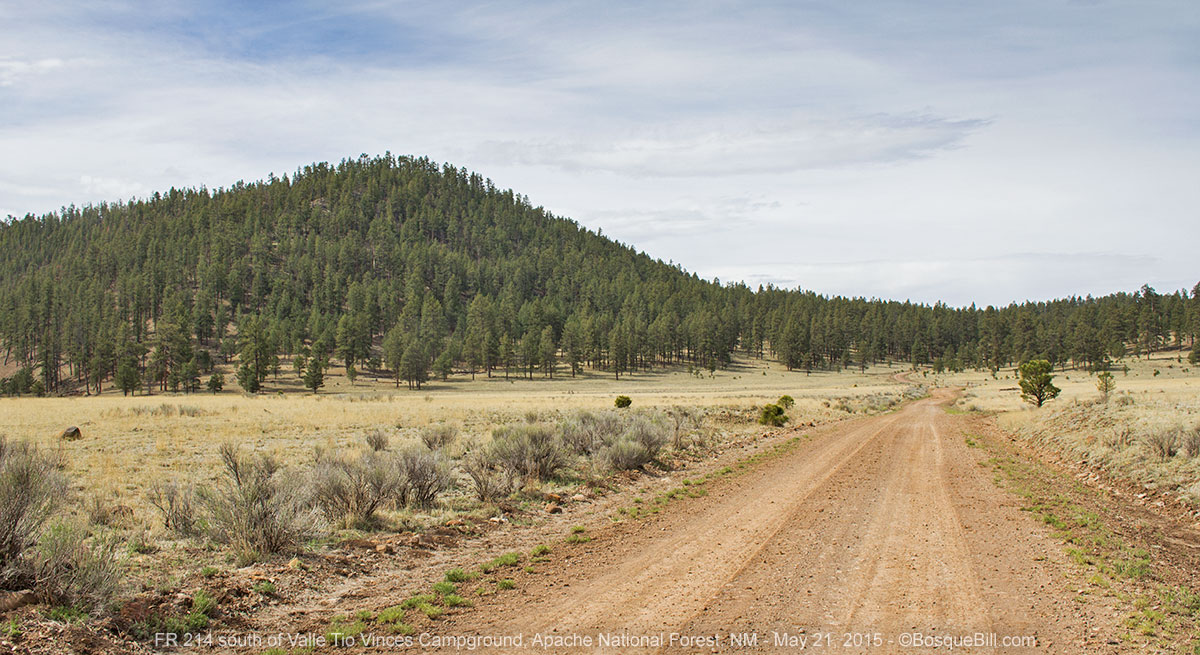
I drove back down the 4 miles to the valley and found a nice level spot in the Valle Tio Vinces Campground, that the lady at the ranger station recommended. It is "partially developed," i.e., there is a vault toilet. I settled in all by my lonesome, had dinner, then about dusk a pickup truck came in, parked across the road and unloaded wood, I thought, and built a small fire. Turns out the other campers were three brothers from Magdalena, NM who were up in the mountains hunting for elk antlers. We conversed for a few minutes and I wished them good night and good luck in their gathering. I wasn't until the next day that I suddenly wondered what they were going to do with the antlers - I guess I was a but slow on the uptake. (The next day I saw a general store in Reserve with a big banner: We Buy Antlers. So maybe that is the simple answer.)
I went to bed and realized it was very, very quiet. The brothers made no noise and this area must not be under any flight path. Before I drifted off, though, a distant pack of coyotes sang me a lullaby.
Thursday, May 21st
It was 26º when I awoke in the morning, but the furnace kept me warm.
Reserve Ranger District, Gila National Forest
On the way to Reserve I checked out Apache Springs Campground, in the woods off the highway. It was nice, but there is no access to the creek. I checked the creek for dragonflies at the bridge, even though it was cool and cloudy. I saw a blue darner, but that was all. I also spotted a hawk land at the tippy-top of an evergreen tree.
 |
| Red-tail lighted briefly atop this tree; can you ID the species from its cones? |
I found the Reserve District Ranger Station just west of town on SR-12. There I solicited advice on where to explore from here and for a recommendation for where to have lunch. Yolanda gave an enthusiastic review of Carmen's back at the highway junction and added that as it was Thursday, the special would be tacos for a dollar each. Turns out they also had rolled, cheese enchiladas for $1.50 each. I ordered two tacos and two enchiladas. She also recommended the red chile sauce, so I made that selection for the enchiladas. Wow. Delicious! The tacos didn't need any extra salsa, as the ground beef was specially seasoned and the lettuce & tomato had a light dressing, too. If you're ever in the neighborhood, stop there for breakfast, lunch or dinner. And yes, the red chile was outstanding.
I filled my tank which was half empty by this time at $3.36 per gallon, quite a bit higher than the $2.49 at Costco near my house. But I did get a free weather report... cloudy, cool, sprinkles and maybe a bit of rain. Not the clear & sunny report I read before starting my trip. Oh, well.
 |
As the "highway" climbed up from Reserve, there was a pretty view of distant mountains to the west.
I believe this is the Blue Range, that I'll drive through later in the trip. |
Sure enough as I drove south from Reserve on SR-435, I ran into a few sprinkles, then a bit of rain. I headed toward Snow Lake, which I'd been told was a lovely area. The road is "paved" for the first several miles, then gravel actually in better condition. The forest along the way was a patchwork of slight wildfire damage and no damage.
 |
| FR-28 cut through this large grassland, home of the T-Bar Ranch. |
Once on top of the mesa, following 28 south, the devastation was much more severe. I turned off on 142 toward Snow Lake amid further fire damage. A few miles in I saw what I thought was a coyote run across the road, then a second one ran across right in front of my truck. My casual impression was that it was a sturdy looking coyote, holding a very bushy tail strait out behind as it loped across the road and up the hillside, but didn't think any more about it at that time.
 |
| Snow Lake |
Snow Lake is nice, and not as low as Quemado Lake. It is in a grassy valley surrounded by unburned forest. There is a campground situated above the lake and there is a loop of sites, suitable for tents or campers, with a nice view of the lake, but without trees it would be vulnerable to winds.
I decided instead to backtrack a bit, then continue south on 28 to the Ben Lilly Campground along Willow Creek. Yolanda at the ranger station said it was a small campground with only 5 sites, but her very favorite in the area.
Ben Lilly and Willow Creek
The campground was lovely and I had my pick of sites next to Willow Creek. As I sit here in my camper, typing this report on my iPad, I'm the only one in this tiny campground. (Note: if you use an iPad for writing, I can recommend the new Logitech Ultrathin Magnetic clip-on keyboard cover. However, I had problems on this trip as the batteries were low. It takes 2 common coin batteries.) I found my spot about 3pm, took a short walk up the creek and on my way back it started raining lightly. I sat in the cab until it let up, then raised the camper roof. It is now 4:30 and it has been sprinkling or raining on and off. I can hear the creek and a few birds singing.
 |
| My campsite. Willow Creek is between my camper and those fir trees. |
The sun came out for a while about 5pm allowing me to walk around a bit before the sky darkened again. I saw a notice posted that endangered Mexican Wolves have been released this area of the Gila. Hmm, that got me thinking about those two unusual coyotes I saw earlier in the day. For more information on the release of these wolves,
click here.
 |
| Here is a view of Willow Creek where it ran past my campsite. |
Friday, May 22nd
It was 26º again this morning. After breakfast it had warmed up enough for me to take a walk farther up the road. The map showed ended at private property about a little ways along. As I was leaving the campground I wished good morning to my neighbors, a couple who had pulled into the campground just as it was getting dark and set up a small tent. This friendly couple, Mark and Maria, had planned to backpack, but didn't realize their route was in a burned out area, so they stopped here instead. They were wondering where to go to continue their trip. I said if they were going to the southern part of the Gila that I strongly recommended the Gila Cliff Dwelling National Monument. They hadn't been there before and were happy for the recommendation.
On my return the Forest Ranger pulled in to the campground for a routine check. I was able to get an update on road conditions from Ranger Tory and ask her if maybe the coyotes I saw had actually been Mexican Wolves that have been released into the area. From my description, she believed I had indeed seen wolves. Cool!
I thought I'd have to backtrack to Reserve, as a sign south of town stated that State Highway 159 was closed between Willow Creek and Mogollon. Tory, however, said it was indeed open and in fact she'd driven in on it this very morning. She said it was a bit rocky in places, but no 4WD was needed. Very good. She also encouraged me to drive into Arizona and explore the national forest there, and not be discouraged by the big wildfire of 2011.
Glenwood Ranger District, Gila National Forest
I broke camp and got on "highway" 159, aka Bursum Road. Once I climbed up out of the canyon, the wildfire damage from the Whitewater-Baldy Fire Complex was extensive all along the ridge.
 |
| Looking across the fire damage toward the north. |
 |
| From the same spot as the previous photo, but looking south up the mountain. |
More information on the Whitewater-Baldy Fire Complex
Once I crossed the divide and descended into the canyon, it was much less severe. But all along the canyon bottom was evidence of flooding in the form of cobble size rocks covering everything along the bottom. I should have taken a photo, but for some reason didn't.
 |
| I spotted this butterfly next to Silver Creek along the canyon bottom. |
The road continued into the old mining town Mogollon [muggy-own] which was probably a quaint little village before the flood. They've had time to make some repairs. And this Memorial Day weekend was to be the official re-opening of the historical mining town (though I was a day early, so even the one cafe was still closed.)
 |
| Northwest of Mogollon was this old mine - I believe it is the historic Fanny Hill mine. |
Alpine Ranger District, Apache-Sitgreaves National Forest
SR-159 led to US-180 which I took north into Apache NF, crossed some lovely scenery into Arizona, and drove into the town of Alpine. I stopped at the district ranger station there which is officially the Apache-Sitgreaves National Forest. Andrea helped me with my enquires and she was very knowledgeable, interesting and informative. She confirmed that the Wallow fire of 2011, though very damaging to some areas, only lightly touched others that were already recovering, and that there were many other areas that escaped the fire all together.
She helped me put together an itinerary that would take me through some scenic areas and provided advice on campground and dispersed camping. She suggested I drive along the East Fork of the Black River where there were a series of small campgrounds. From there I should cut back east, cross US-191 and continue on forest roads through an area where Big Horn Sheep were regularly seen (though she didn't know what time of day they usually appeared.) From there return north to Alpine, then up another forest road where there had been lots of elk sightings.
I took her suggestions heading west on highway 249 just north of Alpine, then south on forest road 276 and into the valley of the East Fork of the Black River. This was indeed a nice area along the small river. There were many open campsites, though many were already taken for the holiday weekend, too. The problem from my perspective was the gusty winds were kicking up dust from the road and carrying it into the campsites. The best site I found felt like it was in the middle of a wind tunnel, so instead of camping, I turned left on FR-24 to look for a dispersed campsite out of the wind.
 |
This TV was sitting on the shoulder of the road next to the East Fork of the Black river.
When I drove up it flew onto this limb to pose for its photograph. |
A short distance along 24 I turned north on the unimproved road 405, where there were a few RVs dry-camped in the meadows. I continued on and took a left fork onto 405C that was too rough and narrow for big trailers and found a pretty little glen shielded from the wind by a nice hill and some trees.
 |
| My secluded and sheltered campsite. |
Saturday, May 23rd
It was a chilly 25º this morning and instead of my usual after breakfast hike, I drove back to 24 headed south through the forest to turn onto eastbound road 26. This was a lovely area of Ponderosa pines, rolling hills and meadows either untouched by the fire or only lightly touched, though the ridges and hill-tops enclosing the broad valley had been throughly scorched.
 |
| Close-up of a Wild Iris along a side road. |
 |
Looking up from the iris bed, one can see the fire came through here only
enough to blacken the tree bark and not hot enough to kill the grasses. |
There were numerous side roads one could take for dispersed campsite, though there were no running creeks or views to enhance one's site. The area north of the last half of the road before you get to the US highway is closed for part of the year to allow the elk a quiet area to raise their calves.
The Blue Range
I crossed US-191 and continued east, now on 567, named Red Hill Road. Within a couple of miles the terrain changed dramatically. Where I had been driving through verdant, forested hills, now the land dropped away into a large, rugged and much dryer canyon land. Where before one could only see a short ways into a meadow or wood, here the vista was across many miles of deep, ridged valleys. There were the red hills off to the right, after which the road is named, and a very dramatic, red sandstone formation next to the road on the left.
 |
| The vista a few miles east of US-191. |
 |
| The Blue Range in the distance. |
I was intrigued by the red sandstone formations, so took many photos.
 |
| An early glimpse of the formations. |
 |
| Another photo as I drive closer. |
 |
| This Wooly Paintbrush was perched on the high side of the road cut. |
 |
| A close view of the formations. |
 |
| Looking back at the red sandstone formations. |
The road continues to wind its way down through this scenic area that reminded me of the southern Arizona mountains such as the Chiricahua. South and west of the road is the
Blue Range Primitive Area. Even though without official "wilderness" designation, motorized transport is still prohibited except along a narrow corridor. The Blue Range is the last primitive area in the national forest system.
From the crossing I proceeded north on County Road 67004 which follows the Blue River for about the first half of its length. This is a dry area, lightly forested, with interesting sandstone formations. There is also some private land along the road.
 |
| One of many formations along the lower portion of the road. |
 |
| This long-eared fellow scampered across the road and paused in this tree to pose for me. |
I returned to Alpine via US-180 and thought I'd try the road where Andrea said there'd been a large herd of elk. She'd suggested going to Nutrioso, then south on CR-2269; I decided to simply start at the south end of that road where it is forest road 81. As I started up the road I realized why she'd suggested starting from the north - the first several miles were though an area that had been badly devastated by the Wallow fire. The road was OK, though narrow and there were run-off bars placed across the road frequently.
I was actually glad I came this way as it was instructive to see the damage and note the aspen returning. Andrea had said the Forest Service planted grass seed by air after the fire and the grasses were healthy. Andrea also said they'd planted wheat and barley in this area as high energy, quick growing fodder for the elk. They don't expect the grains to survive over the years, but to fill the gap until the native grasses are restored. I didn't see any elk at all, however.
 |
| Fire damage northwest of Alpine. |
 |
| Looking south, back up the road from where I took the previous photo. |
I continued up US-180/191 to Springerville where I filled my gas tank and my stomach. I then drove east on US-60 toward Quemado. I hadn't initially intended to backtrack my route home, but by wandering around the way I ended up doing, that was the only logical route unless I wanted to add many miles through less interesting territory.
 |
| US-60 a few miles after crossing back into New Mexico. Rain on the horizon, but I never ran into it. |
Note: the timeline of the trip actually jumps back to Part I at this point in the narrative.
The next published post, however, will cover the time after that at El Morro National Monument.