Showing posts with label Cinnamon Pass Rd. Show all posts

Tuesday, August 10, 2021

Colorado Wildflower Tour - July 2021: Part 1

July 14 - 20. 2021

Featuring: American Basin

Bonus: Northern New Mexico

A Narrative in Three Parts, Plus a Flower Portrait Gallery of American Basin


 Click any photo to enter an enhanced photo viewer with larger images. 

Those who have been following along will recall on my first trip this season I was experiencing some issues with either my camper fridge or batteries. At home I determined the fridge was malfunctioning. These units cannot be repaired sadly. Replacement took longer than I'd hoped and while I was waiting for everything to come together I went ahead and replaced the solar controller with a more modern unit from Victron. I finally got the new fridge installed (email me know if you want details.) Once that was done I did a full load test and discovered my AGM batteries no longer could maintain their output - not surprising as old as they were. So replaced those. Finally ready for camping.

I thought I'd head to altitude to escape the heat and Colorado was the logical choice. Several years ago, however, I stopped going up there in July and August as there were just too many people around every curve and hill. I'd just have to brave it and hope for the best. One good thing about July and the San Juan Mountains... it should be peak wildflower season.

[I try to identify the species, or at least family, of every flower (and critter) I photograph. That might be too big a task considering the profusion of wildflowers found on this trip. Please, if you think I've mis-identified any or have an ID for those I was not able to determine, let me know. Thanks.]


Colorado Wildflower Tour - Part 1 of 3
East Fork of the San Juan River, Cinnamon Pass Road, and special feature: American Basin


Wednesday, July 14th

I drove up I-25 to Santa Fe then on to Española where I stopped for gas and at a Lowe's to replace my scuffed up (safety) sunglasses. It began to rain shortly after heading north on US-84 and was on and off until I got to Pagosa Springs. I'm sure glad I replaced my wipers before the trip. I topped off the gas tank before heading onto the backroads.

East Fork of the San Juan River

I decided I'd try the East Fork of the San Juan River to look for dispersed camping. I'd found a nice spot close to the river there in June of 2014. The turn-off from US-160 north is not easy to find. The faded brown sign "East Fork Campground" is on the west side of the highway where you turn east. There is a pleasant National Forest campground just a mile off the highway that is popular. I remembered that beyond that point the road gets rough. I must have driven much rougher and rockier roads since then as it was not that bad - slow going over small rocks - and only lasts for a couple miles. Dispersed camping opportunities begin at the bridge across the river and can be found all the way until you hit private property. The best spots, IMHO, can be found after the second river crossing. 

I was surprised at how few of the sites were taken and consequently had a hard time choosing between those available. I found a good one next to the river and not too close to any other site. It had a great view up river to distant peaks. It was a little closer to the road than ideal, but there was no dust even though it hadn't rained recently.

Campsite along the river

View from my campsite

Toadflax is considered a weed, but it sure has a pretty blossom.

A splash of color along the roadside.

I sat in my comfy chair and enjoyed the cool temperatures and gorgeous scenery. After a couple of hours I heard some thunder, so stowed my gear just in time as the rains did come. I spent a quiet night until the loud music started about 10:30pm! I had noticed a group camp when I came in, but was sure they were far enough away I wouldn't be disturbed. Boy, they must have had the stereo cranked up. I usually have a pair of soft ear plugs in the camper, but I apparently failed to replace them after cleaning out the camper supplies last year. Damn. A miserable time until they finally went to bed a couple hours later.


Thursday, July 15th

East Fork of the San Juan River (continued)

I enjoyed a quiet camp in the morning as I guess my neighbors were sleeping it off. I walked along the road and took some photos.

This warbler was one of the few on the entire trip who cooperated for a photo.

I also launched my drone to grab a few aerial images.

An aerial view of my campsite.

View above my campsite looking up river.

I drove back out to US-160 and north toward Wolf Creek Pass. I'd forgotten how spectacular the mountain view is on the south side of the pass. 
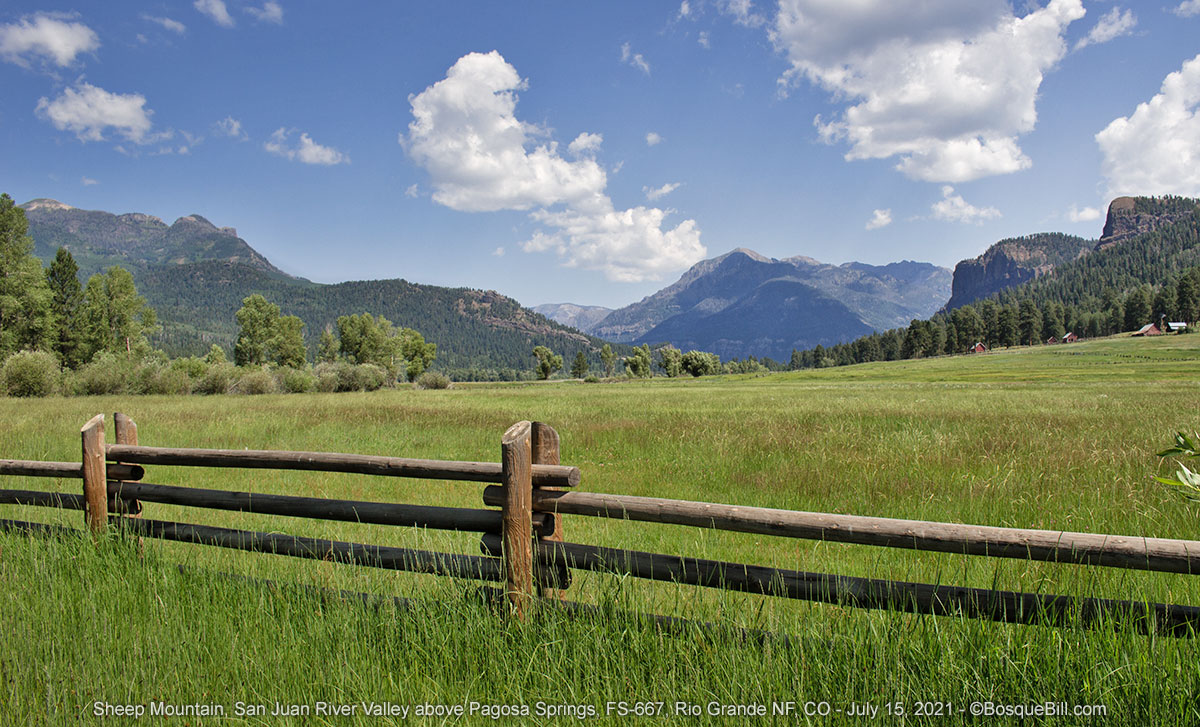
This was the gorgeous view looking toward Wolf Pass (toward the left.)

At North Fork I took CO-149 west, the Silver Thread highway, so named as it follows the Rio Grande northwest. I continued over the high passes to Lake San Cristobal. My ultimate goal was to view the wildflowers in American Basin. Everyone remarked that this was the place to go in July.


Cinnamon Pass Road

My plan, such that it was, had me taking Cinnamon Pass Road to the old Sherman townsite. The road beyond looked like it followed the valley from what I could see via Google Maps. I hadn't driven it before, but last time I was in Sherman some ATV riders said my Tacoma wouldn't have any problems. Well... I might have been able to crawl over the rocks and ledges, but it didn't look promising for campsites, but did look likely to rip the bottom out of my truck. I prudently made the decision to abandon the road at a point where I could turn around.

I didn't want to continue up Cinnamon Pass Road this late in the afternoon, so decided I'd check if one of the 'secret' dispersed sites I had found several years ago were available. They are just downstream of the Mill Creek BLM campground in a small segment of public land sandwiched between private property parcels. Yes, there was an open site near the river. However it was a bit muddy and with clouds of mosquitoes. No thank you. There were another couple sites across the road with nice views, not as soggy but there were just as many bitters there.

Williams Creek Campground

Well, when Plans A and B fall through, it's time for Plan CG. I knew only a few miles down from there was the Williams Creek National Forest campground. I often drive though campgrounds in likely areas for future reference, but for some reason never had here. I pulled in and there were a couple of folks walking down the road with their dog. I asked if they knew if there were sites available and they said there were. I drove through the good looking campground trying to figure out the system used for holding the sites - a pink square of paper with a date, but some of those sites were obviously occupied, others not so much.

Anyway figured it out with the help of a couple nice ladies in a fancy van, and found a pleasant site hopefully far enough away from the huge trailers that would be running generators later. The site had a nice curtain of conifers in any case, though not much of a view.

My campsite at Williams Creek.

After setting up I walked around the loop road. I stopped for a while to talk with Ken and Terry, who I'd spoken with on my way into the campground. They had a 5th wheel trailer and a big pickup truck and a energetic dog. We talked about other places we'd camped and places to visit. They mentioned American Basin as a great place for wildflowers and they were taking their "side by side" (small ATV with two seats together rather than fore & aft) up there the next day, maybe they'd see me there. Nice folks.

Later that evening at a site next to me I met John and Kathy as John was starting a campfire. They had a smaller trailer pulled by a mid size Jeep. They are from Montrose, CO which made them almost locals. They come up to Williams Creek for a week about every year. John invited me to share the campfire (or to be honest, he warmly welcomed me when I invited myself). We also had a good discussion about camping and locations to visit in the area. Not only good folks, but Kathy brought marshmallows to toast and we made s'mores!


Friday, July 16th

Williams Creek Campground (continued)

I recalled from previous excursions up Cinnamon Pass Road that sections were rocky and bumpy. So even though I was not going over the pass I decided to lower the air pressure in my tires to slightly soften the ride and provide plenty of grip.

Now, a shout-out to Chad from Kansas. On my way out of the campground when I saw two men in fishing gear at another site. I stopped to ask if they had any luck or if they were just heading out. They said they were just now going. Then one of them asked, "Are you Bill?" Beyond surprised I replied merely, "Yes." "I'm Chad" he said. "I read your blog!" Good thing I was sitting down or I might have fallen over LOL. He recognized my rig and had read some of my posts about the camper and Tacoma. We chatted for a few minutes. I learned his family had had a cabin in Lake City for many years and used to come up for summers in his youth. Amazing. This was a first and started my day with a big smile.

Cinnamon Pass Road

[You may notice large stands of dead trees in many of the following photographs of high forests in the southern San Juan Mountains. As I have cataloged in previous posts, these dead trees are due to Spruce Beetle infestations. Unfortunately, drier and hotter conditions weaken the trees and cause them to be even more susceptible to these pests.]

As I drove up the middle section of Cinnamon Pass Road, past the Sherman turn-off, I started to see orange ribbons attached to branches that hung out over the road. At first I thought they were cheap, plastic tape used to mark trees to be removed. But as I spotted more they looked substantial and I noticed a white label on the ribbon. Finally one hung where I could reach out and examine it. The label said something like "Do not remove. Course route for the Hardrock 100." Hmmm. Interesting.

When I got to the large meadow where the trailheads for the Silver Creek & Grizzly Gulch trailheads are located there was much more activity than usual. There were vehicles packing the parking areas and lots of tents including larger canopies covering tables. I had intended to try to take a spherical panorama of the valley with my drone, so walked away from the concentration of people and launched. 

 
360º aerial panorama of Burrows Park at Grizzly Gulch/Silver Creek Trailheads.

A fellow asked me if I was with the race. "No", I said, "What race?" He went on to explain the Hardrock 100 endurance run and that this point was an aid station. 

The Hardrock Hundred Mile Endurance Run is an ultramarathon of 100.5 miles in length, plus 33,050 feet of climb and 33,050 feet of descent for a total elevation change of 66,100 feet, at an average elevation of over 11,000 feet. The run is held on a loop course on 4WD roads, dirt trails, and cross country in Southern Colorado's San Juan Range, USA.

I continued up Cinnamon Pass Road.

Mount Edith at the head of Burrows Park


American Basin


First view of American Basin
I had passed the basin turn-off to American Basin when I traversed Cinnamon Pass in October of 2019. I'd been seeing plenty of ATVs and some other high-clearance vehicles on the road. It seems many, if not most, had headed to this destination. One can see isolated or small patches of wildflowers along most mountain highways in summer, but most everyone recommended American Basin in July as the ultimate. Though my new friends in the campground last evening remarked that there were fewer than in some years, perhaps due to less snow than usual this past winter.


360º aerial panorama of American Basin.

Nonetheless, the profusion of wildflowers in the basin was wonderful and so many different species, too! I stopped a couple times for photos as I worked my way to the very end of the road where I parked and walked just a bit farther. There were hikers going farther up the valley. There were lots of regular folks taking photos of the flowers and landscape.

Here are a few of the landscape and wide-field photos I took in the basin. 

I have placed specific flower photos in the separate American Basin Wildflower Gallery post.


It was a mostly sunny morning, but by the time I got to the basin at 11am, the clouds were building. (By the way, it took about an hour to drive from the campground to Grizzly Gulch and another hour to reach American Basin.) After an hour and a half I'd taken nearly 150 photos. My eyes were starting to cross and the clouds were getting heavier. Time to head back down.

View down the basin toward the route back.

As I began driving down the mountain it started to rain. Then the rain became heavier, though not a deluge. It rained for a bit more than an hour. After passing the race aid station at Grizzly Gulch I was able to see a few of the runners coming up the road. The first fellow looked like he had plenty of energy and was observing all around him. I gave him a thumbs-up. The  next half-dozen runners looked like they were low on energy with their eyes firmly on the ground in front of them. At least the aid station was nearby where they could rest, dry off, and grab a snack.

Desert Paintbrush on south-facing rocks along the roadside.

Shortly after gaining the lower part of the road I spotted two cars stopped with their passengers hanging out with the phone cameras pointed down toward the river. I've learned to stop in these situations. Sure enough there was a moose foraging in the river. I had the perfect lens mounted and took way too many photos, but this was the best moose opportunity I'd had in my travels.

Moose in the Lake Fork of the Gunnison River.

I had flirted with the idea of staying another night at Williams Creek, but it was still early in the day so I pushed on. I stopped at an ATV staging area by Lake San Cristobal to pump my tires back up to highway pressure and set off toward Gunnison via Lake City.

Friday, October 9, 2020

Video: Autumn Color in Southwestern Colorado

This video is in 4K UHD. I recommend you watch it full-screen. [Note: the Safari browser will only play video in HD, so if you have a 4K screen I recommend Firefox or another browser.]


Beautiful views of colorful aspen and oaks covering the mountainsides and valleys of southwestern Colorado. Locations listed below. The images were captured during my trip of September 30th through October 3rd, 2019, in the San Juan, Gunnison, and Rio Grande National Forests of Colorado.

Timeline and locations:
0:00 Intro; Minnie Gulch - FS-24, off FS-2, east of Silverton
0:29 Bristol Head & North Clear Creek - CO-149 and FS-510
1:40 North Clear Creek Falls - FS-510 off CO-149
2:32 Weminuche Overlook - CO-149, the Silver Thread Scenic Byway
3:05 Lake San Cristobal - Cinnamon Pass Rd (30) south of Lake City
3:15 Cinnamon Pass Road - County Rd 30
3:35 South Mineral Creek - FS-585 west of Silverton
5:16 Ragged Mountain - near west end of Kebler Pass Road, County Rd 12 west of Crested Butte
5:30 Marcellina Mountain - Kebler Pass Road
6:03 Lost Lake - FS-706 off Kebler Pass Road
6:13 Beckwith Mountain - Kebler Pass Road
6:34 Ruby Mountain - Kebler Pass Road
6:54 Snodgrass Mountain - FS-317 north of Crested Butte
6:59 Sawatch Range - FS-472 north of Taylor Park
7:13 Spring Creek Reservoir - FS-744 north of Almont

Additional information on all areas is available on my Backroads Travel Blog for this trip.

The easiest way to find any specific posts is either to use the Blog Map Page, in the header above, or the index of Topics and Locations in the right-hand column of each post.

Aerial video was taken using a DJI Mavic 2 Pro.
Editing assistance by Acme Enterprises.

Sunday, November 10, 2019

Colorado Autumn - October 2019; Part 2

Continued from Part 1

Tuesday, October 1 (continued)


Note: If you click on a photo you can see a larger version - highly recommended.

Cinnamon Pass


I'd driven the lower section of Cinnamon Pass Road a few years ago as far as Grizzly Gulch. It is very narrow and clings to the side of a steep slope. I remembered it was very bumpy, so had aired down my tires before leaving Sherman. I also had recently mounted a new set of tires, so had sturdy rubber tread.

Barely over a mile from the Sherman junction, the road traverses a steep, narrow canyon.

The road is alternately rocky & bumpy and smooth & flat as it passed through the "parks."

Small, colorful aspen grove next to the road.

The road will go left of that conical rock prominence before climbing up to the pass.

The scenery was dramatic with the surrounding alpine peaks. For the most part the road, though rough, wasn't too technical - at least until the fork to American Basin. At that point there is a sign on the pass road warning 4WD vehicles only. (As an aside, I've heard from a couple sources that American Basin is great for summer wildflowers. One fellow I talked to later in the trip recommended late July.)

I had been noticing there were long poles attached to the many steel posts delineating the edge of the road the whole length - see photo below. At one point I passed a pickup truck with the emblem of the county road department - the two man crew were the ones attaching or re-attaching those poles. I assume that's to help find the road in deep snow, though I doubt they plow this section and know they do close the road in winter.

Looking back (and ahead) after a very steep, narrow section of switchbacks.

This next stretch of road up to the pass had some "interesting" sections - sharp switchbacks, rocky humps, and super narrow shelf roads. I met three trucks coming down, thankfully up nearer the top where there was room for them to pull over and let me by. This section is a bit "technical" and not for the faint of heart (or those with a fear of heights.)

I found the landscape to be stark and beautiful. I know the pass is named for Cinnamon Mountain due to it mineral color, but I thought it was interesting the ground cover was also cinnamon in color this autumn.

I paused at the pass, took a few photos and tried to keep my feet in the gusty wind.

Cinnamon Pass (12,640')

The view back from whence I came.

The view west where I am yet to go.

One of this group of riders was not having a good day. His bike was laying off the road.

View back up to the pass.

The road leading down from the pass to the west looked less challenging and that proved to be the case. Although the last mile or so before Animas Forks was unpleasantly bumpy even with low tire pressure and required me to slowly creep along. This area in the San Juans seems to have rocky roads that are no fun to drive, IMHO.

Animas Forks


Animas Forks townsite, mines, and mills.

As I came down from the pass I stopped in the middle of road, as there was nowhere to pull off, to take a couple photos of the old mining town and surrounding structures. Animas Forks gets it name as this is where the Animas River forks into the West Fork and North Fork.

Animas Forks townsite

I was disappointed that the light this late in the day seemed to be coming from the wrong direction for the best exposures, however. There was some wind, but I did fly a mission to try and get aerial photos of the town.

Animas Forks. Aerial photo 'shopped to minimize the back lighting.

Another aerial photo of the townsite.

A gentleman, and his wife, came over to talk to me about my drone. He was fascinated and I had fun talking to him about it. They live in Durango and run a travel coupon business.

I thought if I could find a camping spot not far away I'd try for photos again in the morning. Camping is not permitted in the Animas Forks area within 800' of any historic structure and that pretty much meant there was only one site in the area and it was already taken. I decided to drive up the road along the West Fork of the Animas River to look for camping. I only drove a couple miles, but could see there would be not be even anyway to pull off the awful road.

Aerial photo of the Frisco Mill structure

On the way back down I did stop for photos at one old structure that Google Map labels Frisco Mill at Bagley Tunnel. I was able to get on its west side where there was still good light. Most of the mines in the Silverton area are tunnel mines, there are a few exceptions such as Yankee Girl that have vertical shafts.

Frisco Mill structure

I abandoned my effort to find camping anywhere near Animas Forks and started down the road toward Silverton hoping to find a camp site farther down. Little more than a mile down from Animas Forks there was the remnant of the avalanche that had blocked the road until August. Though they managed to carve a path for the road, it is still about 15' at the tallest point and about 40' wide.

Road to Silverton

A more modern mine across the canyon seen on the drive down.

I stopped briefly at Eureka Gulch to check out the campground there. It's a private facility that is closed for the season. I talked to a group of men who'd been camping there and they said it was open to the public for free camping at this point. There was a lot of downed timber and the wind was whipping down the canyon. I found one mostly sheltered spot, but there were lots of flies. So I continued down the road.

Minnie Gulch


A little more than a mile farther down I spotted a forest service road with a sign, Minnie Gulch. I drove up the road as it climbed up a few switchbacks then along a steep slope. It crossed a small creek about a mile along and then I saw mine ruins on the left and an old building next to the road. About a quarter mile farther I saw a short spur where I could pull a ways off the road. It was close to level and there was a fire ring, so had been used as a campsite before. As it was getting late, close to 6pm, I set up there. It was next to tall trees that sheltered me from the wind, another plus.

My campsite. Photo was taken the next morning when there was better light.

Turned out to be a nice, impromptu site, and though close to the road, no one came by the whole time I was there. The creek happily bubbled and babbled through the night, keeping me company.

Wednesday, Oct 2


Minnie Gulch (continued)


At some point from the last evening to this morning I decided to change my plans. While at home I'd created an itinerary though the mining district high above Silverton, but two things were on my mind. First, the fall colors were bursting out with abandon which is a short lived event; and second, I was already tired of being jolted by the rocky roads on these mountains. I would head down to Silverton, check South Mineral Creek Road to see if there were autumn colors that way, then head over to Ouray on the way up to Delta and the back road to Kebler Pass Road east of Crested Butte. A total gamble regarding the timing, but I knew there were miles of aspen groves along there. OK, new plan in place.

Aerial view of my campsite

My map showed a mine site farther up the road, but I'd have to climb a ways to get there and had no information if it was a cool site or not. So after I let it warm up a bit, I took some photos from the ground and air.

Aerial view down the canyon

I headed back down pausing at the mine ruins just below.

I'm thinking this was a miners dormitory for the mine just below.

Mill foundation located just below the photo above.

It was a beautiful drive down the gulch this brilliant morning.

Just before descending the switchback I found this view, looking down toward Siverton.

Eureka Gulch


The Eureka site was only a mile back up the road so I headed that way first. The buildings of the Sunnyside Mill are long gone, but it has an extensive foundation that stair-steps up the mountain side. Seemed like an opportunity for someone with a flying camera.

Sunnyside Mill 

Aerial photo of mill foundation

I then drove down to Silverton where I stopped at the grocery store and bought a deli sandwich to take with me.

South Mineral Creek


I didn't drive all the way to the end of the gravel road. There were groves of aspen on the north side, but not the south. I took some aerial photos and video from a couple of places.

Aerial panorama looking up the canyon

Aerial panorama looking down the canyon toward Silverton

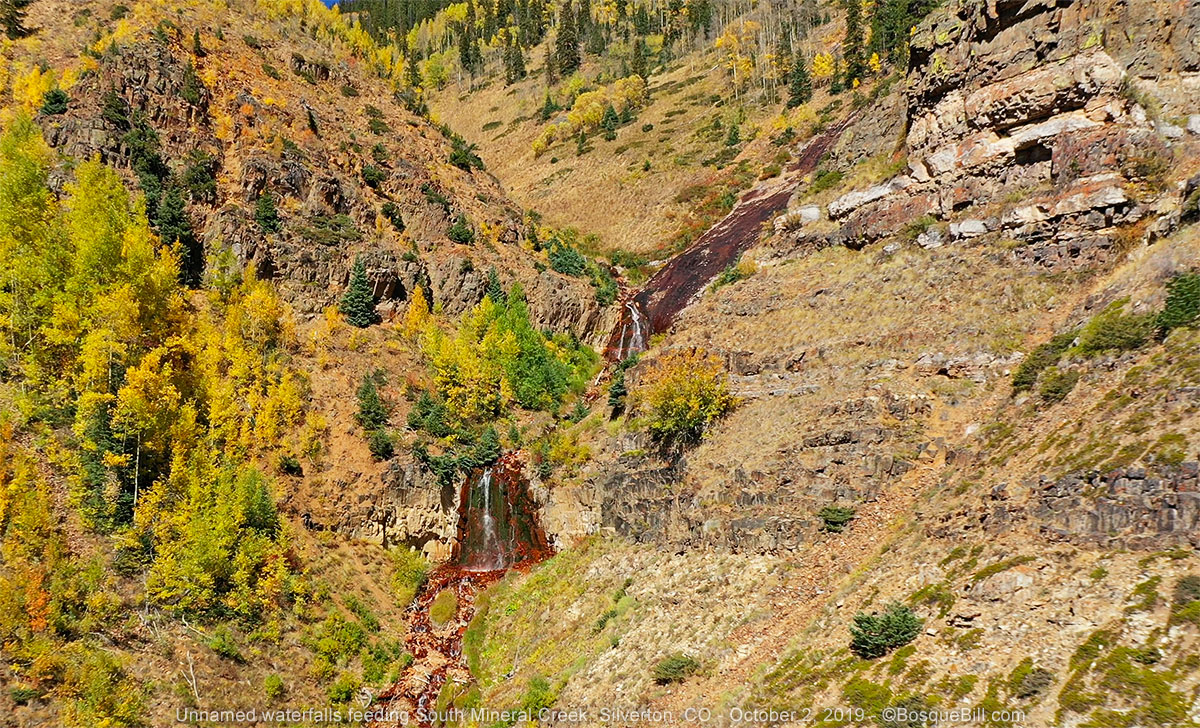
I also discovered waterfalls I didn't know existed. They're on a small stream that feeds into South Mineral Creek. They're located on the north side of the road. I flew over to them to capture the detail below. (If you expand the image above, you can see them in situ near the left edge of the photo.)

Waterfalls on the north side of the canyon.

Million Dollar Highway


Before leaving South Mineral Road I refilled my tires with highway pressure. The drive to Ouray was beautiful. Not all the aspen had turned, but the colors combined with the natural minerals of Red Mountain created a lovely palette.

View of Red Mountain from US-550 between Silverton and Ouray.

Journey continues in Part 3.