Carson National Forest, New Mexico
September 26 - 29, 2023
This is a continuation of my September trip that started with a visit to Rio Grande del Norte National Monument. I broke this trip into two independent parts. To continue... After deciding not to camp at Wild Rivers Recreation Area I returned to the highway and drove south on NM-522.
Click on any photo for a larger version!
Tuesday, September 26
Questa
I filled my gas tank in Questa, just to be on the safe side, and looked at my Carson National Forest map as I'd remembered the turn off I would want was a little tricky. Actually it's a lot tricky. You go east on NM-38 toward Red River. The map has you thinking you take an immediate left, north, but you have to go almost a mile east before you see the sign to Cabresto Lake, FR-563, aka Cabresto Road. There is a clearly visible sign, so they're not hiding it, it's just not where you'd expect.
Cabresto Road
Once you leave Questa the road become gravel with significant washboard, but also enters the forest, with trees right up next to the edge of the road. The route follows Cabresto Creek past a few summer cabins. About 6 miles from the highway is the turn-off north to the lake. You now will have to climb 2 miles of rocky, rough road. The sign says "Not Suitable for Passenger Cars" and that's mostly the case, though a careful driver in a car with some undercarriage clearance could make it up without incident. Still, it's not the most pleasant road. I met two vehicles coming out.
Cabresto Lake and Campground
Cabresto Lake was created behind a concrete and earth dam. The lake is known for being one of the few places where one can catch brook trout. Though I was told by fishermen that the best spot for brookies is Lake Fork Creek where it enters the lake. Elevation is 9,500 feet.
This primitive campground is officially recognized as such by the forest service, but it is much more "informal" than the usual USFS campground. There is a vault toilet in the middle of the parking area, which is the end of the road. There is a picnic table at the edge of the parking area next to the hill; another a little ways up that hill with a small level site for a tent and a sloped parking space; a walk-in site on the north side of the road just as it gets to the parking area; and two (or three) sites without tables along the south side of the road a few hundred feet before you get to the lake.
I camped at the lake once in 2016 and my site was on a slope beyond what I could level, but I did have a view of the lake, which was my goal at the time. I re-read my post from that visit: I recommended simply camping in the parking lot as the day hikers and those fishing would leave before dark.
When I arrived there was one 4Runner camped in one of the sites located before you get to the lake. The gravel parking lot was completely empty. I walked around looking for a level spot that would have a bit of view of the lake (there are trees between the parking lot and the lake) and that would get sun for the solar panels the next day.

|
| My campsite at the edge of the parking area next to the lake. |
I found a nice location along the lakeside edge near the gate to the dam access road. I could get a bit of a view and, as I was at the end of the lot, I'd be out of the way of folks coming in the next morning. It was about 6pm by the time I was all set up and could sit and enjoy the evening. The lake level was quite a bit lower than when I'd been there before, of course that was June and not September. The clouds of earlier in the day were long gone, so there wasn't much of a sunset.

|
| View of the lake from the dam access road. |
Wednesday, September 27
Cabresto Lake (continued)
I had the place to myself the next morning. The sun rose over the eastern mountains about 9am and was pleasant to sit there drinking my coffee and watching the antics of the many, many chipmunks. After a while a SUV with two older couples came in and parked. They were going to hike up the trail to Heat Lake and back—about 5 miles each way. Sounded ambitious to me, but they did look to be in better physical condition than your humble correspondent. (I talked to them again when they returned later in the afternoon and learned that they'd not made it that far after all.)

|
| Despite there being many, many chipmunks constantly around I only managed one good photo. |
Lake Fork Creek Trail
The hike I'd made up Lake Fork Creek on my original visit had been a highlight, so I was looking forward to a second take. I put a picnic lunch in my camera bag and set off about 11am. It was a glorious day with clear blue sky and mild temperatures. The trail is narrow with plenty of ups-and-downs as it follows the creek. Much of the time you can only hear the water rushing nearby. At one point a side channel runs right next to the path. A very beautiful hike.

|
| Entering the wilderness (composite photo) |
Although only a few aspen were contemplating color change many smaller plants, bushes, and deciduous trees were well into their autumn finery. There were only a few wildflowers this time, in contrast to the many wildflowers along the trail in June. After about 2 miles I found a little grassy area to sit and have my lunch before heading back to camp.

|
| Leaves beginning to celebrate the season |

|
| Beautiful colors |

|
| Sometimes the creek was down a steep slope... |

|
| ...sometimes is was right next to the path. |

|
| More autumn foliage |

|
| I spotted this interesting caterpillar next to the trail. |

|
| Lake Fork Creek |

|
| Late season Scarlet Gilia |
Click video for a short clip:

|
| The trail returns to Cabresto Lake. |
Campground Host?
After my hike I set up my chair to admire the view of the lake and surrounding mountains. The weather was perfect. I'd make occasional forays to photograph the scenery or butterflies; the birds were all around but refused to hold still for a photo.
I found it amusing that I seemed to fall into the role of host. A car would come in and the couple would ask me how to go down to the lake. A truck would come in and the gentleman would ask me where he could camp. Another gentleman asked where there was good fishing. Someone else asked where the trailhead was located. Luckily, I knew the answers. LOL.
On one of my short perambulations I discovered the prolific blossoms on a chamisa bush nearby were covered in butterflies. I don't think I've seen so many crowded around one plant before. I snapped lots of photos and managed to get a few nice ones.

|
| This chamisa was extremely popular with the butterflies. |

|
| Milbert's Tortoiseshell |

|
| Painted Lady |

|
| A very orange Red Admiral |

|
| Forewing view of a Red Admiral |

|
| Hoary Comma |
By evening several of the campsites just before the parking area were occupied. All but one were out of sight and all were quiet. The parking lot cleared out well before dark.

|
| Afternoon view of my camp |
That night as I went to bed I heard an owl calling nearby.
Thursday, September 28
Cabresto Lake (continued)
A quiet morning with a few high clouds in an otherwise blue sky. I would move on today, though in no particular hurry. I planned to reverse course from my first visit to this locale—down the mountain, up Cabresto Road, over the mountain to Red River, then up over Bobcat Pass, through Eagle Nest, and up the switchbacks on US-64. I would find the forest road I came out on and wind my way to Rio Chiquito and the lovely campsite I had found those year ago.

|
| A last view of this gem of an alpine lake |
Cabresto Road FR-134
The drive down the mountain from the lake was easier than the grind up. I turned left, east, when I reached the bottom. I noticed once again that there were many dispersed camping sites along Cabresto Creek for the first couple of miles east of the lake junction. Some looked nice; some looked well worn.
FR-597
I don't know if the road up and over Sawmill Mountain to the ski town of Red River has a name, but it is well marked at this end. It climbs quite high before cresting. Along the way up I took a few photos of aspen that were trying to decide if they wanted to turn yellow yet.

|
| Heading up the mountain toward Red River |

|
| Coming down the other side of the mountain. |
Red River
I drove through the resort town of Red River, which was quite busy with tourists. Red River has been a popular ski town and is also a favorite summer destination. I'd hoped to stop at the public library and borrow their wifi, but turns out that Thursday is their late opening day so I was out of luck. My needs were not so great as to try another source so I continued east on NM-38, Main Street.

|
| A view of the ski slopes and town of Red River. |
Eagle Nest
It's a gentle climb up to Bobcat Pass and from there the highway dropped slowly through open meadows to Eagle Nest where I turned right on the highway, US-64. Looks like Cowboy's where I used to stop for lunch is still closed.
I found out they are rebuilding and widening the highway from the bottom, near the Angel Fire turn-off, all the way up to Palo Flechado Pass. The narrow road needed it. I had to wait at least 15 minutes for the pilot car, but at least that gave me plenty of time for a snack and to study my map to make sure of my turn-off to Rio Chiquito.
Valle Escondido
You get to FR-437 from Valle Escondido Road and it was clearly signed. This was the forest road that would lead to my old campsite and from there west to the highway and out. There were some extremely rough patches of basalt that crossed the dirt road. I sure didn't remember them being so bad from when I came out this way years ago. I was concerned I was on the wrong road, but it had been clearly marked and there hadn't been any junctions. I guess I just didn't remember.
The road finally crested and came out to a large meadow area. I was ready for a break to relieve myself. I got back on the road and continued on. I didn't know it at the time, but I'd made a big mistake. I followed the road straight though the next junction, but that took me onto FR-438, not 437. I should have gone right at the junction, not that it was marked or anything. Had I taken the right road, it was only about 3 miles to my destination.
As it was I wandered for another hour or two on bad roads, seeing no one. I even came to a dead end at a canyon edge where both my GPS maps showed the road continuing on. I had to turn around and backtrack quite a ways. I had realized by this time I had missed a turn somewhere. Looking at the map and Earthmate app I thought I found a route that would take me where I wanted to go. So I followed that road until I got to a junction. There was a beat up sign on the road that I needed to take that warned the road was closed as the bridge was out. Ai-yi-yi. No choice but to take the other fork which would take me... somewhere.
At least this road was fairly wide and in good condition. After a few miles I saw an ATV coming from ahead—the first people I'd seen in hours. I waved them down and asked for help. Luckily the older couple were from Eagle Nest and were a little familiar with the area. Long story short, I learned from them that the road I thought I needed was indeed open. The bridge had been replaced over a year ago. Once again I backtracked and turned down the road toward my old campsite. I still had several miles to go, but did indeed come out onto FR-437, finally!
From that junction I turned back east. Very soon the road turned left up the hill. There is a spur that continues up the valley with a sign designating it as FR-437CG. CG for campground, I surmise. Though there is no campground some older maps do indicate one is there. From the turn-off it was about half a mile to my campsite. Whew! Made it!
Rio Chiquito
I found the exact campsite, next to the creek, where I'd stayed before. A very pretty site with a manicured lawn curtesy of free range cattle. They were not around, but had left several nearly fresh cow patties I had to avoid. Before setting up camp I decided to drive a bit farther up the road to see what was there. In the next meadow a couple were camped in a van with some sort of tent semi-attached to the back. There were a two lawn chairs set out and a black dog, but I didn't see the people.
Looked like the road ended just beyond there. I remembered from last time a berm had been built to close the old road—a possible hiking trail for the morrow. I returned to "my" meadow and made camp. With the longer than anticipated drive it was after 5pm before I was set up. When I'd been here in June the wild meadow was filled with wild flowers, but only one or two survivors this time.

|
| My campsite with the little Rio Chiquito just behind the camper. |

|
| Rio Chiquito |
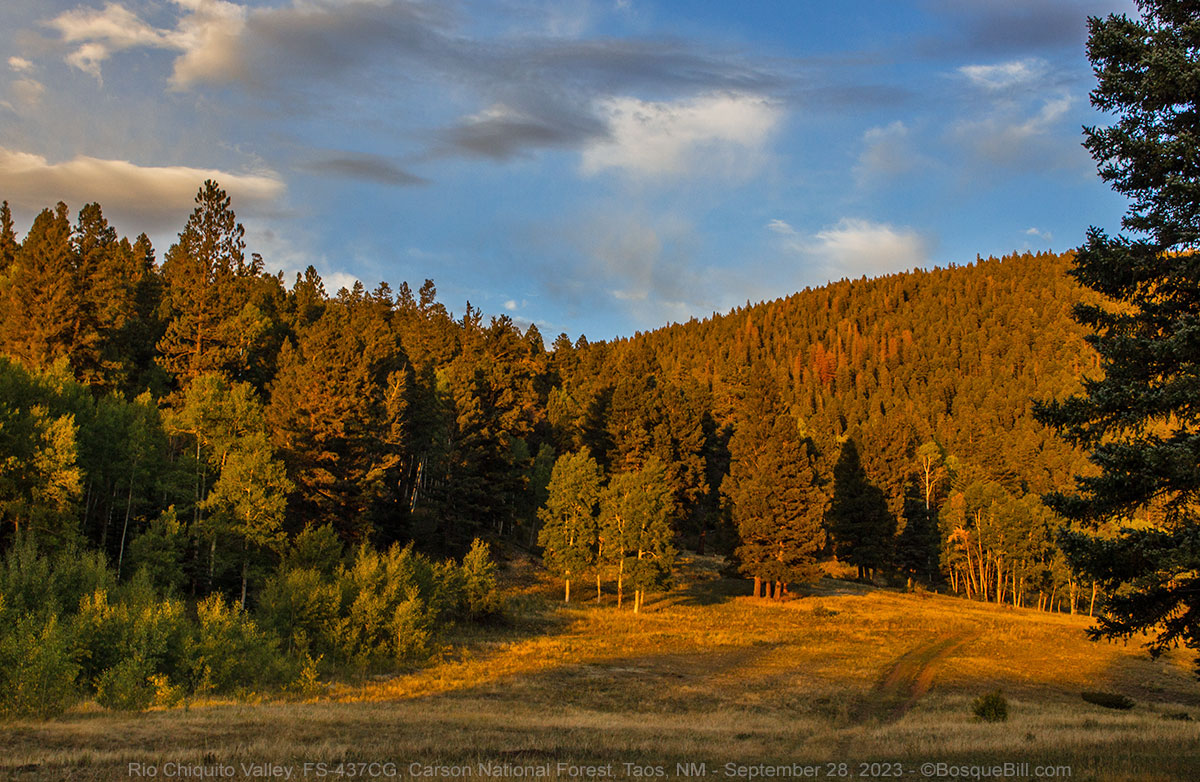
After dinner I noticed reddish light shining on the ridge across the meadow. I took the camera to investigate. Not long after I was treated to a colorful sunset.
|
| Red light from the sinking sun illuminating the ridge across from my campsite. |

|
| Colorful sunset as seen from my meadow. |
Friday, September 29
Rio Chiquito (continued)
Every previous morning on this trip the outside temperature had dropped into the low 40ºs F. This morning it was a frigid 24º outside! Yikes. I'd requested a weather forecast on my inReach the previous evening as I was thinking of spending the day camped here. The forecast claimed 0% cloud cover all day and moderate temperatures with rain on Saturday. When the sun tried to rise above the ridge there were heavy clouds. It stayed below freezing for a couple of hours, so I stayed inside, drank hot coffee, read some of my novel, and ran the furnace from time to time.

|
| Such a lovely spot, but very cold and cloudy. |

|
| The clouds seemed to be spreading instead of dissipating. |
As the cold morning progressed the clouds seemed to be getting heavier and spreading. By 10am it had warmed up enough to walk around outside if bundled up. I took some photos. I was trying to decide whether to stay or head out. It was still cloudy, but could clear... or not.

|
| Looking across the meadow which is full of wildflower in summer. |

|
| This tree near the creek was getting into the spirit of the season. |

|
| These harebells were the only flowers I found in the meadow. |

|
| An aerial view showing the creek and my camper. |

|
| An aerial view east, farther up the valley. |
If the weather improved I could drive down to Tres Rios and camp another night, or I could call it good and head home. I decided to pack up and break camp. I would choose between another night camping and home later.
Rio Chiquito Road - FR-437
By the map it's only 12-1/2 miles out to the highway, but it took about an hour and a half to drive. Again there were very rocky stretches of basalt that I hadn't remembered from last time which required slow going. The road follows Rio Chiquito creek through some pretty scenery. Beavers had been at work along the creek and later I caught up with the cattle that had trimmed my lawn. There were a number of dispersed campsites in the upper reaches of the road and a few sprinkled along its length. I stopped at one of those and had lunch.

|
| Beavers had been at work here. |

|
| I took this photo to show the little sunflowers off to the side. |
Once within a few miles of the highway the terrain opens up and the lower elevation featured different ecosystem. There are several dispersed campsites, too, though more likely where teenagers come to party and drink beer.

|
| Cottonwoods at this lower elevation provide a little color. |
High Road to Taos [NM-518, NM-75, NM-76, Sombrillo Rd]
I took the scenic route south. None of my few photos were interesting enough to include even though the route is scenic and highly recommended. The "High Road to Taos" is a recognized scenic byway between Santa Fe and Taos (actually more like between Española and Ranchos de Taos.) It connects many traditional communities in this beautiful area. I turned left on NM-518 from the forest road. The highway slowly climbs a long valley up to Pueblo Peak where there's a viewpoint. It's pretty, but too early for aspen in this area.
I'd left the clouds behind, but hadn't decided if I'd spend one more night camping or not. By the time I'd descended down to NM-75 I felt like I'd had a very good trip and a hot shower sounded better than another night in the camper. 75 goes through Peñasco then the route turns south on NM-75 and goes through Chamisal, Trampas, Truchas, and Chimayo. Then at Sombrillo I took 106 which connects to US-285.
The route is essentially freeway from there. I bypassed Santa Fe, then drove the interstate home. It was 88º along that last stretch and I wondered if I'd made a mistake winterizing my evaporative cooler at home before the trip. Luckily my house was a comfortable 73º inside.
Thanks for reading along. I hope you enjoyed the trip. There will be one more journey this season, so stay tuned.


