In Search of Autumn Color
 |
| A reprise of the map showing my overall journey. Presented as a convenience. |
Part 3 of 3: October 7th through the 9th
This is the last installment of the story of my trip to Colorado to find and enjoy colorful fall leaves. In this section I drive south from Leadville, along the Arkansas River, then explore Marshall Pass, and finally take the Silver Thread Byway, CO-149, toward home.
I also ran into a bit more adventure than I'd anticipated, so read on.
Tuesday, October 7th (continued)
I headed back south from Leadville on 24. This pretty valley is the headwaters of the Arkansas River. I was still not sure where I wanted to go from here. The high clouds had continued to build and the weather report at the ranger station noted the increased chance of showers in the following days. I decided not to take Cottonwood Pass back over to Taylor Park, figuring those high country aspen were likely past peak and into bare branches. South of Buena Vista 24 heads east and US-285 comes in from the north; I continued south on 285.
I passed by the dramatic appearing Chalk Cliffs with the thought to explore up that road on another trip when it would be safer to head up into the high country. I found cheap gas in Poncha Springs and asked an old timer there if there wasn't a ranger station just up US-50 from there. He said it was just a ways up on the right, so I headed east in search of local information. Turns out his directions were out of date; the old station had closed. I had to stop at the Chamber of Commerce visitor information to learn a new, modern station had been built just southeast of Salida along 50.
A very nice and knowledgable lady at the Salida Ranger Station answered my questions about various routes and alternatives. I liked her suggestion to take Marshall Pass Road, FR-200, back south on US-285. She said it was one of her favorite drives for fall aspen. She also suggested I might like to camp at O'Haver Lake campground, but cautioned it might be a bit smokey, as there was a prescribed burn nearby.
Marshall Pass
I took that route and looked at the campground. It was pleasant enough, but more of a destination for those who want to spend time lake fishing, and it was very smokey and no aspen. I continued up the road. Higher up there were only a few colorful aspen. I kept my eyes peeled for dispersed campsites, but only saw one and it didn't grab me. It was close to 5pm by the time I got to the top of the road, there were a few side roads here, that might lead to camping, but it was also close to eleven thousand feet, so might be a bit cold.
 |
| The obligatory photo of the sign at the pass. |
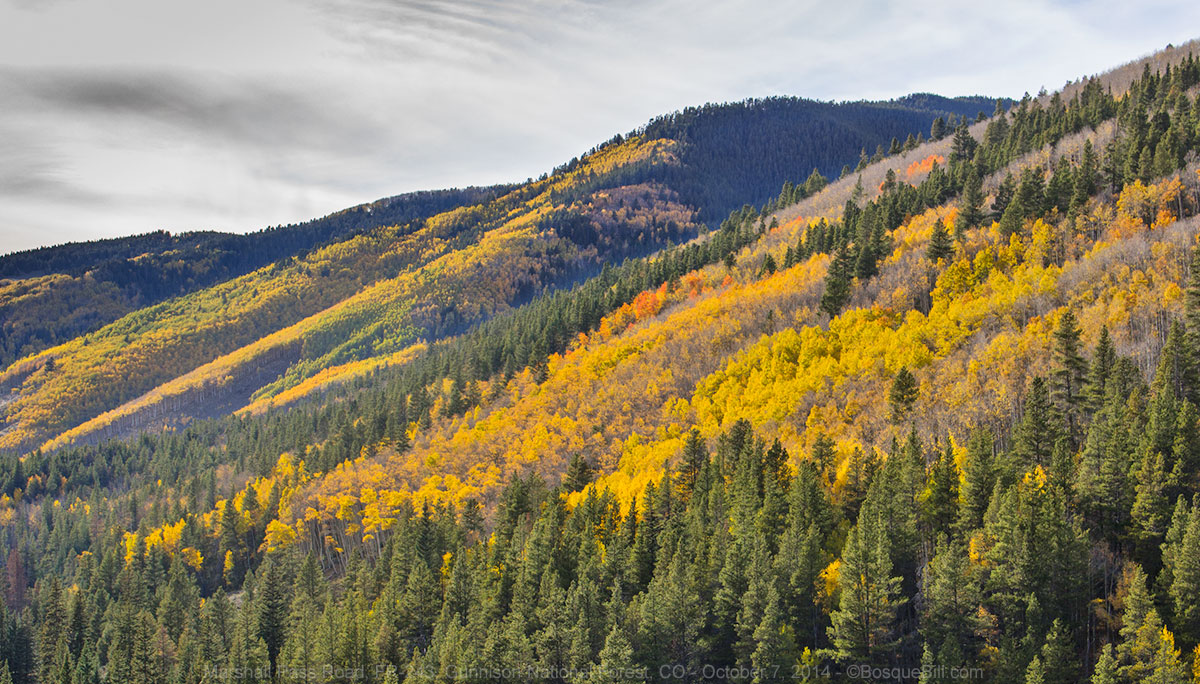
At Marshall Pass, the road changes from FR-200 to FR-243 as it enters Gunnison National Forest. I headed down the road and noted there was more aspen color in this side.
 |
| Colorful mountainside |
 |
| A patch of brilliant color captured using the telephoto lens. |
 |
| I obviously like these photos of aspen leaves seen through the white tree trunks. |
There were also more deer along here than I'd seen anywhere else on my trip. As the road continued to descend, I passed a few camping areas, but as they were right next to the road, I continued on. The road follows Marshall Creek and then entered into private land. I saw from my map there was a side road heading north, FR-242.2A and tried up that way for camping. There were a couple of nice sites, but they were occupied. There was another far off the road, but not particularly level or pretty, so I continued up the road. There was nothing else and then I hit the boundary line for the Pinnacle Mine, so I turned around and took the one open site I'd seen before. It wasn't as nice as the others I'd had on this trip, but it was getting late and I managed to find a portion of it that was close to level and without too many cow pies.
 |
| My campsite off a side road off Marshal Pass Road |
Wednesday, October 8th
I still didn't know where I wanted to head from here. I understood that the weather was turning, so generally heading in the direction of home made sense. Marshall Pass Road comes out on US-50, so I could either head east from there to check out the aspen approaching Monarch Pass, then down 285 toward northern NM; or west to either turn south on CO-114 and hence NM: or continue on through Gunnison, then down CO-149 which would take me by Lake City, then south along the Rio Grande. I'd come up 149, named the Silver Thread Byway, earlier in the year and knew it to be a beautiful, scenic drive, plus I thought there might be aspen to view around Lake Cristobal above Lake City. This last idea won the day.
Lake Fork of the Gunnison
I drove through Gunnison, then south on CO-149. The first part of the route is through drier, lower terrain, then it goes up and over and down to along the canyon of the Lake Fork of the Gunnison River. There were some photo opportunities here, mostly cottonwood rather than aspen, but colorful. I noticed a side road dropping down into the canyon and turned around to explore that. It ran next to the river, right up against the canyon wall to the trailhead for Devil's Creek. There was an interesting truss bridge, but I didn't explore farther.
 |
| A scenic spot right along the Lake Fork of the Gunnison River near Devil's Creek |
 |
| Truss bridge across the river just north of the previous photo. |
As I was taking photos of the bridge and river I noticed the battery level indicator flashing on my camera. Oops, I hadn't been checking that and I could have easily recharged using my 12v/120v converter the night before. Well, I was almost to Lake City and it was lunchtime, so I would look for a cafe where I could plug in my charger while I had lunch.
 |
| Highway to Lake City with Carson Peak in the background |
I found the Tic Tock Diner and the nice waitress found an outlet for me to use. I had a Tic Toc burger and by the time I was finished the battery was charged enough to get me through.
The road to Lake San Cristobal, County 30, is a few miles south of Lake City. This is the same road that goes to Cinnamon Pass (closed for the season.) Although slightly augmented by man, Lake San Cristobal was mostly formed by an ancient landslide that blocked off this fork of the Gunnison River.
I pulled in to the north end of the lake for photos. By this time it was between mostly cloudy and overcast, but still very pretty.
 |
| Lake San Cristobal and the gathering clouds |
I then thought I'd head on up the road to look for more photos and this is where I ran into that adventure I promised.
Predicament
I passed the lake and the wide, dirt road continued along the river. At one point I saw a spot for a photo, but was past it before I could stop. I threw the truck in reverse to back up and get the shot, after checking there was no traffic. I was obviously not careful enough as I ran the two right-side wheels off the road. At that point there was a steep drop of three to four feet to the ground. I put the truck into 4WD and tried to drive out, but that caused me to actually slip father off. I put on the parking break and took a deep breath.
Just then a fellow and his wife came by and stopped in their John Deere ATV. The driver said "Looks like you're in a bit of a predicament." That was an accurate statement! I replied "Do you have any suggestions?" He said that if he'd been in a larger truck he could pull me out. I replied that I had a front hitch that would take a shackle, maybe that would help. His idea then was to pull from the side which might help keep my truck from sliding farther into the ditch. He was concerned that if we messed up my truck would tip over on its side, but I was hopeful this scheme would work. I dug out and installed the shackle mount on the front hitch and found the recovery strap which I'd also had the foresight to carry. We double-doubled up the strap so it would be short enough. He asked if I wanted to take a picture. If he hadn't brought it up I wouldn't have this evidence of my foolishness.
 |
| Not a good spot to be in, but at least I had recovery equipment and a good samaritan to help. |
The plan was for him to keep tension on the front of my truck at an angle and help pull the front back on the road with the rear following as I eased out in 4WD. It took two failed attempts for me to remember I'd put on the parking brake - do'h. Once I disengaged the brake I was able to easily drive back on the road with the help of the ATV. Whew! Am I ever thankful I'd put on that front hitch earlier this year and bought those very basic recovery accessories. That easily saved me hundreds of dollars and the time and stress of getting a tow truck up there. And thankfully the event did no apparent damage to the tough little Tacoma.
I wasn't going to let that stop me, so took my photo, then drove on up the road for a while longer to see what was there. When I got to the point where clearly there would be no more autumn colors I turned around and drove back to the highway.
 |
| Upper Lake Fork of the Gunnison River |
Slumgullion Pass – Spring Creek Pass
Continuing southeast on 149 most of the aspen were gone by. I again marveled at the enormous geographical area between Slumgullion Pass and Spring Creek Pass that is utterly decimated by the Spruce Beetle (Dendroctonus rufipennis). There were large groves of aspen in this area, too, whose branches were totally bare of leaves, though I was told later at the ranger station in Creede that the aspen are fine; they had just lost their leaves, probably from a recent wind storm.
The farther south you get from Spring Creek Pass, the less affected the spruce are by the beetles. There are some interesting side roads around the North Clear Creek Falls area, specifically FR-510, 509 and perhaps 532, as well. The views of Bristol Head Peak are magnificent. I do want to come back this way next year and spend a couple of days exploring this area.
 |
| Bristol Head seen from the Silver Thread Byway |
Creede
I learned the name Bristol Head and about the Spruce Beetle at the ranger station in Creede. I had just driven on by this old mining town on my previous trip up 149 earlier in the year. I drove through downtown this time and saw for the first time the dramatic canyon just north of the village. I asked the nice lady at the station about that, too, and she told me about the scenic loop through the old mining area. She marked it on their vehicle use map, which she gave me, and said the Chamber of Commerce could provide more information ˗ See Bachelor Historic Tour on this page.
You may, or may not, recall that I live near the Rio Grande just outside Albuquerque. The river at home is wide and always muddy, and sometimes barely flows at all. So I enjoy seeing The Rio in its upstream incarnations. Beginning west of Creede, 149 follows the Rio Grande to its end (the route, not the river.) I didn't take photos of Wagon Wheel Gap, where the river and highway, squeeze between the canyon formed by Blue Park and McClelland Mountain, as the light was poor and my photo earlier in the year is still online (scroll down this page if you're interested.)
Palisade of the Rio Grande
 |
| Day-use area of Palisade Campground along the Rio Grande |
The cliff along the edge of Blue Park is called the Palisade, and on my previous passage, late in the morning, I'd driven through Palisade National Forest campground which is between the highway and the river.
 |
| The Palisade for which the campground is named |
It was a small, very pretty, wooded campground. I was fascinated that several sites were right next to the clear, rushing Rio Grande and thought at the time that it might be fun to camp there sometime. This would be that time. It was only 4pm, but I'd driven late the day before and if I passed this site there would be no others for many hours.
 |
| A campsite along the river, though I ended up choosing another site. |
 |
| The Rio Grande River seen from my eventual campsite |
 |
| My campsite seen from where I took the previous image. |
There were no other campers, just one family having a picnic gathering, so I had my choice of sites. I chose one, walked around taking photos, them moved to another site with a better view of my river. I felt very lucky for several reasons: the campground was beautiful with views of the Palisades and many cottonwoods and willows in their autumn colors; the campground was indeed still open – it doesn't have a gate, and is low enough in altitude, that I suspect it remains open year around; there were no screaming kids or barking dogs; and as a bonus, the forest service had removed the cash box, so camping was free.
 |
| I love vanishing-point photos |
An additional “feature” of the campground is a train track running through the middle of it. The first time I saw that I thought, yikes, but as it is only used for the Denver & Rio Grande Scenic Railroad between South Fork and Wagon Wheel Gap, I was not worried about noise. It runs Tuesday through Saturday, but only though October 5th.
 |
| An old boxcar used for storage and a maintenance car of some sort. |
 |
| I was intrigued by the latch on the boxcar door - old school tech. |
 |
| The tracks leave the campground, headed down river toward the station at South Fork. |
I carry a small battery/crank-powered radio which includes the weather radio channels. Most of the time when I'm back in the mountains I cannot pick up a station. As the weather seemed to be closing in, I tried again this evening. I was able to pick up the station for the San Luis Valley to the east. The forecast was for rain tonight and tomorrow with snow at elevations and travel advisories for tomorrow night. So I put aside thoughts of camping in northern New Mexico and planed to head directly for home the next day.
Thursday, October 9th
I woke in the night to the sounds of rain. It was raining in the morning, too, and naturally that was when I ran out of propane in the bottle to which I was connected. The temperature was mild, so I wasn't worried about the furnace, but to be unable to make coffee, that would not do. I waited a few minutes for the rain to lighten up and slipped on my wind breaker, the closest thing I had to a raincoat, and stepped outside to swap the hose to the other bottle. That was the last break in the rain, so I wrapped my cameras up in plastic, gathered everything I needed to move to the cab, and prepared to get wet breaking camp.
Well, the thing about the aluminum camper roof is that it makes a light rain sound like a torrent. I was able to pack up, lower the roof, and hit the road without getting very wet. I knew though that I'd need to raise the camper top at home, when it was dry, to keep mold and mildew from forming on the sides.
South Fork – Homeward Bound
It rained all morning. I stopped briefly in South Fork, the end of the Silver Thread Byway, to take photos out the truck's window of the D&RG RR station to illustrate this blog.
 |
| Train station at South Fork |
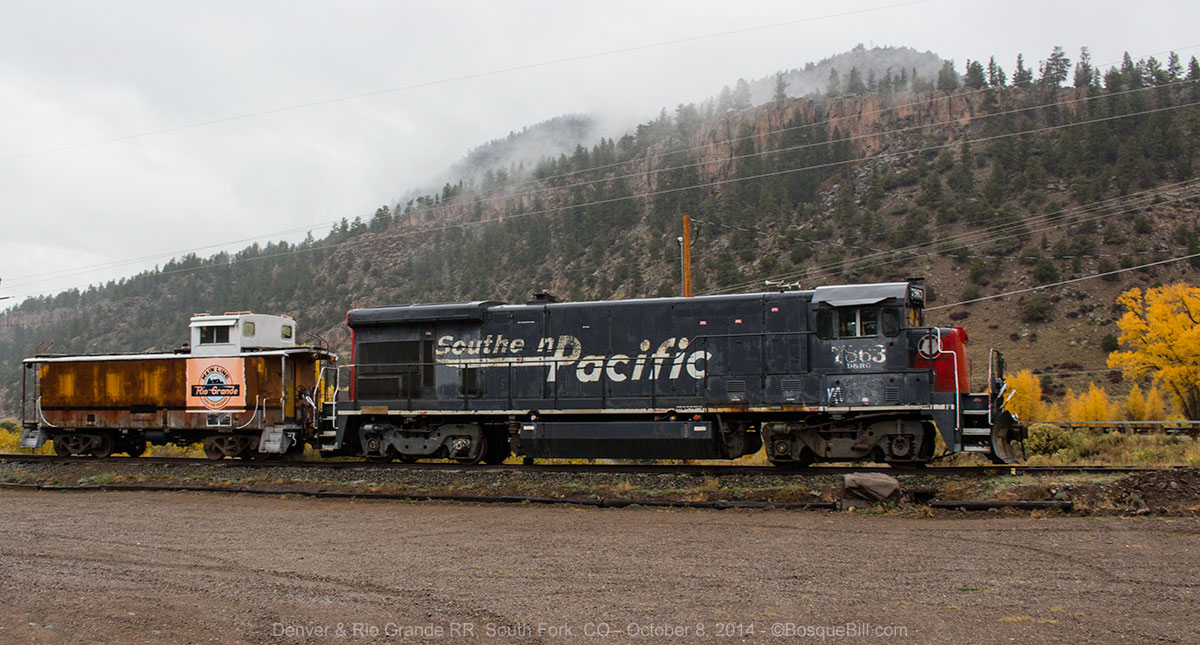 |
| Engine and caboose parked next to the station. |
It was still raining in Monte Vista. It was raining on and off by the time I reached Alamosa where I gassed up. It mostly stopped by the time I reached the village of Antonito, where I returned to the Dutch Mill cafe for an early lunch, a.k.a., breakfast.
It was overcast, but mostly dry as I continued south into New Mexico. I looked over to the west to the mountains where I had originally thought to continue camping and it looked like it was pouring down rain there. Turns out that Albuquerque had rain in the area, too, though it was pretty light. When I got home, the driveway was wet, but nothing was falling out of the clouds as I unpacked the truck and camper.
I think this was my most enjoyable camping trip of the year. The scenery was fantastic. The weather was great until the very end. I was lucky in finding good campsites. I had a little adventure that I escaped due to my foresight and even more luck. It's getting late in the season and with other unforeseen events, this might be my last trip for the year. If so, it was a good one. Thanks for coming along after the fact!


